
What Canada’s Defence Industrial Strategy means for Canadian Industry
On Feb. 17, the federal government released its much-anticipated Defence Industrial Strategy (DIS). If you’ve been following Texture’s analyses, you know this is the one we’ve been waiting for. National security is now industrial policy, and industrial policy is the bedrock of diplomacy.
The DIS responds to that reality with a new centre of gravity: the Defence Investment Agency (DIA), and a procurement doctrine designed to be blunt on purpose: “Build-Partner-Buy.” The DIS sets explicit targets to increase the share of defence acquisitions awarded to Canadian firms, grow exports and scale Canadian defence revenues dramatically over a decade. But many promises hinge on implementation mechanics that are not yet visible, including spring legislation to establish the DIA as a stand‑alone entity, and spring/summer 2026 frameworks on industrial and technological benefits (ITBs) and a new “champions” program, which may echo or envelop the Quantum Champions program launched in December 2025.
The through‑line we’ve been seeing holds: Canada needs to move faster than we ever have before. A few weeks ago, Washington told allies they are done with “book reports,” they want to see action, deals and results. The DIS is Ottawa trying to build a machine that can keep up with procurement, innovation, workforce, and supply chains, before allies and adversaries force our hand.
The Brief
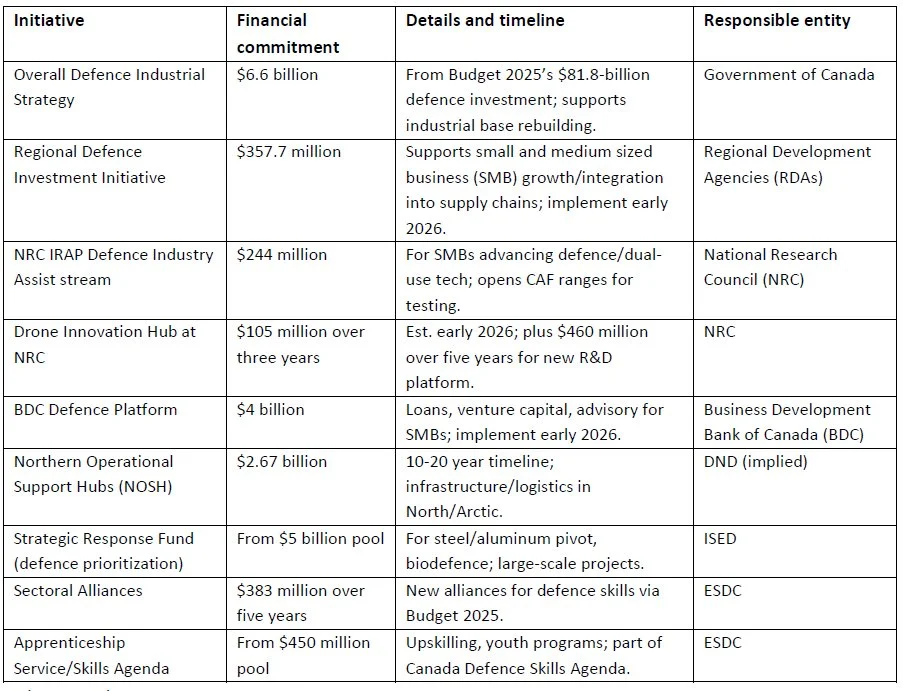
The DIS explicitly links defence readiness to economic resilience, tariffs, and industrial competitiveness. The government positions it as a companion to a generational defence investment, including a stated $81.8-billion Budget 2025 pledge and $6.6 billion directed to the DIS itself.
The document sets 10‑year targets that imply procurement volume, sustainment demand, and industrial scaling requirements:
Increase defence awards to Canadian firms to 70 per cent
Raise fleet serviceability targets (maritime 75 per cent; land 80 per cent; aerospace 85 per cent)
Increase defence exports by 50 per cent and grow small and medium-sized firms (SMB) defence revenues by $5.1 billion annually.
Create 125,000 new jobs across the economy.
The DIS describes defence procurement as fragmented across departments and explicitly positions the DIA as the solution that will consolidate processes and reduce duplication. The DIA was created in October 2025 and is intended to become a stand‑alone entity via legislation in spring 2026, meaning the most consequential governance details are not yet in statute. If you want to influence what they are, this spring will be an important time for your lobbying efforts.
“Build-Partner-Buy” is the core operating logic of the DIS, and it tells you how Ottawa intends to buy for the next decade:
Build domestically for home‑grown strengths and sovereign capabilities, using directed procurement as a matter of policy, potentially enabled by procurement/legal adjustments including the national security exception.
Partner where Canada lacks capability or joint development is advantageous, explicitly emphasizing the European Union, the United Kingdom, and Indo‑Pacific partners, while still affirming our relationship with the United States.
Buy off‑the‑shelf when necessary, but with conditions to protect sovereign control such as IP, and to force reinvestment into Canadian industry.
The DIS also included an initial list of ten sovereign capabilities where build‑in‑Canada will be prioritized: aerospace, ammunitions, digital systems (including quantum and AI), in-service support, personnel protection (including medical counter measures), sensors (including marine, quantum, and electronic warfare), space, specialized manufacturing, training and simulation, uncrewed and autonomous systems (drones).
Finally, the DIS is unusually explicit on near‑term timelines, with important pieces coming soon:
The introduction of DIA stand‑alone legislation: spring 2026.
A “Champions” identification and onboarding framework: by summer 2026.
The publication of ISED’s ITB reforms: early 2026.
The release of a defence‑critical minerals strategy to expand the production, processing, stockpiling, and procurement of defence-critical minerals: by Q2 2026.
The creation of a Drone Innovation Hub in early 2026 at the NRC with $105 million over three years. It will acquire a new R&D platform with $460 million over five years.
The roll-out of $4-billion through BDC’s Defence Platform in early 2026.
Establishing a new Science and Research Defence Advisory Council in 2026.
Publishing a detailed BOREALIS roadmap and select the first round of funded research projects: by Q3 2026.
Launching the new Canadian Defence Industry Resilience (CDIR) program to help secure key supply chains for the Canadian Armed Forces, with investments beginning in 2026.
Introducing a Canada Defence Skills Agenda focusing on four priorities: strengthening the defence industry talent pipeline, investing in urgent defence sector skills needs, growing the supply of skilled labour, and partnering with provinces, territories, and Indigenous rights holders.
Standing up a dedicated unit to boost Canadian defence exports, including the addition of new Trade Commissioners in the UK and key EU markets.
And establishing a permanent Defence Advisory Forum.
What this means at 50,000 feet
Canada’s most important industrial files are being pulled into a national security frame: space, critical minerals, cyber/AI/quantum, dual use infrastructure, and defence manufacturing are now on the same chessboard.
The DIS makes “sovereign control” a theme and repeated condition, particularly around intellectual property (IP), sustainment rights, and avoiding foreign lock‑in when buying advanced platforms. This is a recognition that if Canada is late, we become a buyer rather than a partner, standards will be written elsewhere, intellectual property (IP) will be offshore, and Canada’s right to maintain, repair, upgrade and operate our own defence technologies will be stripped from us and held by foreign powers.
Ottawa explicitly commits to formal strategic partnerships to build Canadian “champions,” including directed procurement and support for R&D and capital expenditures, paired with expectations on delivery and Canadian supply chains. Here, the government explicitly wants examples of firms and projects it can point to as proof that defence spending is creating jobs, sovereignty, and growth. As Texture noted back in December, Ottawa will need real‑world examples that embody DIS priorities including sovereign capabilities, dual‑use tech, Indigenous partnerships, and Arctic relevance. The released DIS is effectively a framework for selecting those examples.
Risks and opportunities
The DIS is constructive and ambitious. It is also vulnerable in predictable ways. The governance is still partially conceptual. The DIS states an intent to legislate the DIA as stand‑alone in spring 2026, but the authorities and accountabilities will ultimately live in legislation and implementation directives that are not yet available. The document also does not yet describe a reporting cadence or procurement service standards that would make its ambitious targets auditable in real time.
And the strategy’s supply chain ambition, including critical minerals, munitions inputs, and northern infrastructure, runs into the Canada‑specific constraint we’ve flagged repeatedly on minerals: you cannot become a trusted supplier at allied speed if projects cannot be permitted, financed, and built at allied speed. The DIS’s defence‑critical minerals strategy commitment is important, but the test will be whether it produces a short list of deliverable projects with timelines, not another set of aspirations.
Financial Commitments
What to do now
Texture writing is blunt for a reason: our clients do better when they act early, before frameworks calcify and lists get written without them. In January, we wrote that those who read these strategies as a roadmap have a better chance of being in the room when decisions are made. Below is the DIS‑specific version of that playbook:
Choose your sovereign capability lane and say it in one sentence. If you cannot point to one of the 10 sovereign capabilities and explain your role in it, you will be treated as generic “innovation,” which is exactly what Ottawa is trying to move past.
Write your Build-Partner-Buy story as a one‑page briefing, not a deck. One paragraph per component: what you can build in Canada; where you can partner (EU/UK/Indo‑Pacific/U.S.); and what your sovereign control conditions are (IP access, sustainment rights, data control).
Build a “Champions” narrative. Start positioning yourself as a champion. Assume that the core criteria, based on the DIS’s stated intent, will include domestic governance, Canadian IP control, supply chain integrity, relationships with allies, and credible delivery capacity.
Map your government relations around the DIA ecosystem. The DIS explicitly locates DIA as the centre coordinating procurement and industrial benefits. That means GR strategies that only target DND or PSPC will be incomplete.
The team at Texture Communications is currently working with clients in defence, quantum tech, and critical minerals. Our clients become industry-moving thought leaders through powerful communications, and they get government funding and approvals through our lobbying efforts. Work with us to ensure your story is heard and your most important projects are built.
Interested in reading the full Defence Industrial Strategy? You can find it here.